Winter Carnivore
A Seasonal Eating Guide to Better Hair
March 5th, 2026
From December 30th to February 23rd 2026, I did a strict carnivore diet (no cheating). I ate only animal flesh, fat, organs, and plain broth, with just salt. I mostly ate beef and lamb, with salmon, shrimp, and oysters on occasion. I have done carnivore dieting on four other occasions, for 6 to 8 week stretches. And while the way in which I executed the diet has varied, by the end of the diet, each time, my hair looked a lot better.
Here are the hair results from an 8 week carnivore diet that I did from the middle of March until the end of May (8 weeks) back in 2022:
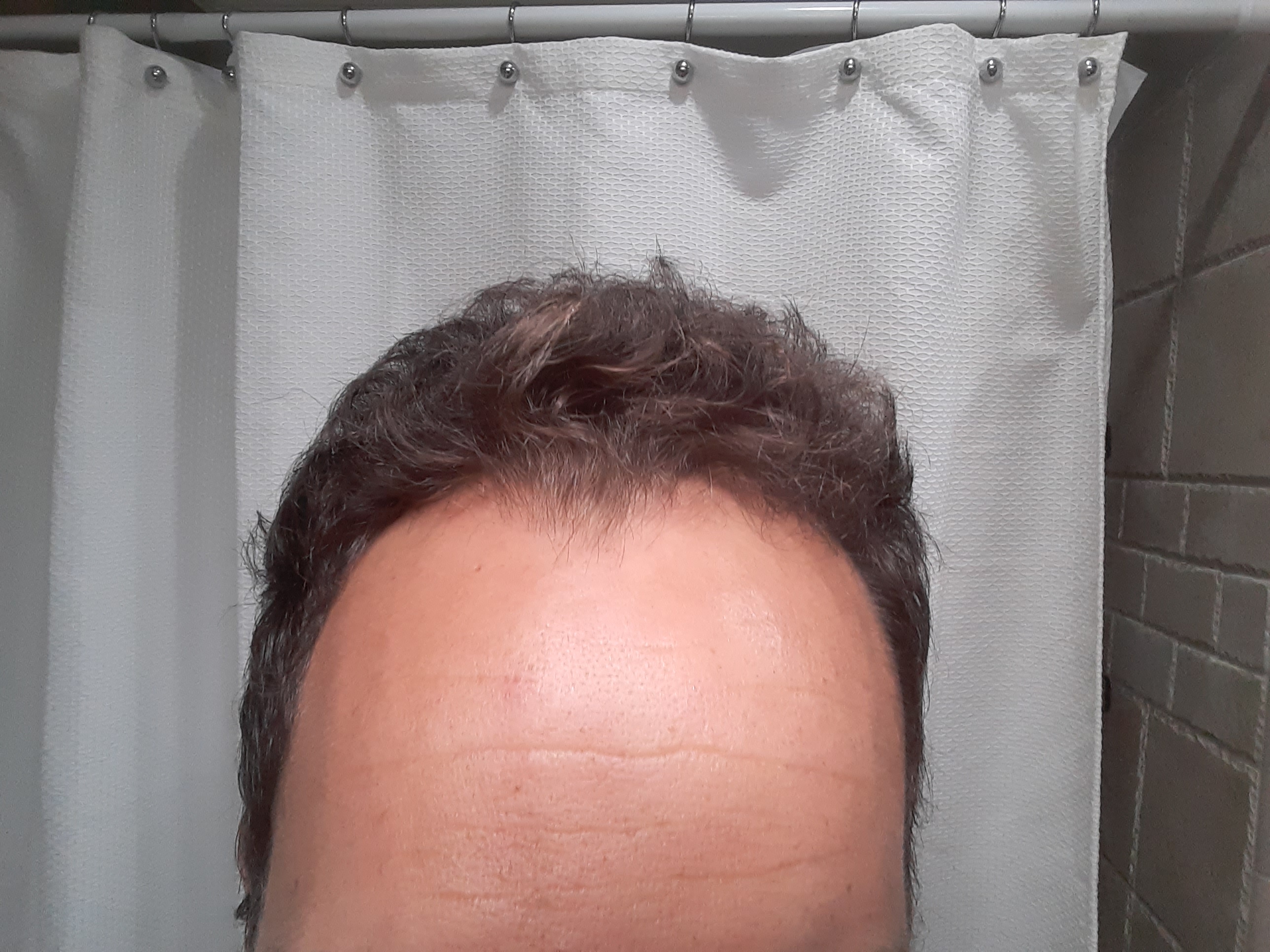

And here are the hair results after 8 weeks on carnivore this time (note: I took the before photo a few days into the diet):
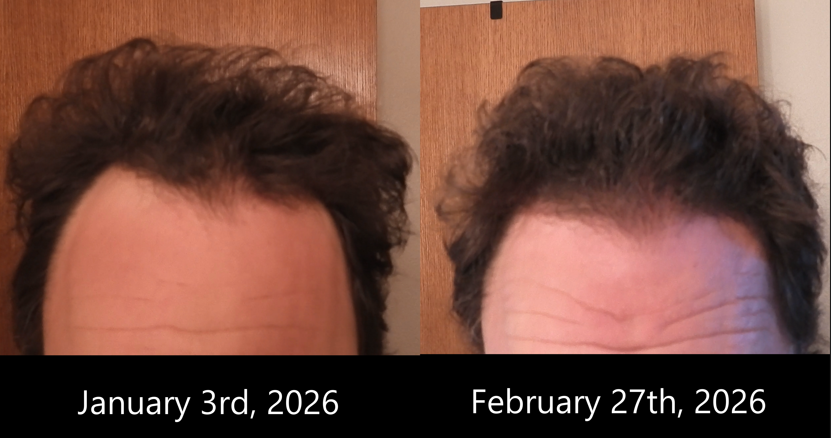
I do NOT claim that I grew back a single hair on my slick bald receded hairline while doing this diet. I noticed NO new vellus hairs or any new growth whatsoever. Rather, what I DID notice was an overall improvement in the appearance and volume of the existing hair. My hair seems to perk up, poof out, and come alive after about 6 weeks of carnivore (sometimes less). As a result, it becomes much easier to style and hides the bald areas much better.
As to why a carnivore diet would have a positive effect on hair, I can only speculate. I used to believe that it was all a matter of gut health and reducing inflammation. The idea being that plant the fibers and natural protective chemical compounds are harsh on a damaged gut, which is common in modern living, and feeding on starches year round will upregulate certain strains of bacteria in the gut flora to abnormal proportions, which can have negative side effects. So, taking a break from plants will give the gut lining a chance to heal, which keeps inflammatory elements from passing through the gut lining, and starves some over-grown bacteria strains in the process, which has cascading positive effects on normal bodily functions, such as growing hair. However, I'm not so sure now. It could be that, but I just don't know.
But whether it's the gut flora reconstitution, reducing inflammation, or something else entirely, all I know is that it JUST WORKS. That being said, I do not believe that carnivore dieting is a long-term solution to male pattern baldness. It may improve the health of existing hair, for some reason, but I doubt that it will stop or reverse pattern loss. The reason being is that it does not stop the skull from changing shape after puberty, which is the unique cause of male pattern baldness. For more information on the role of changing skull shape in hair loss, refer to pretty much the rest of this website.
Besides hair, there are other reasons why I was inspired to do a carnivore diet again this winter, and specifically in the winter, which I'll explain in this blog post. But first, here's a breakdown of how I executed the diet this time to avoid all of the common negative symptoms when attempting a carnivore diet, all of which I have experienced, such as insomnia, fatigue, nausea, unwanted weight loss, and diarrhea.
CARNIVORE DIET EATING GUIDE
The following is a more detailed breakdown of each of the food categories, and how they each help facilitate a smooth, enjoyable, and nutritious experience on this rather extreme elimination diet:
Raw Meat - the purpose of consuming meat raw is maximize the B12 content consumed. While I am not confident that there is such a thing as a vitamin B12 anymore, I do believe that there is some nutrient in animal flesh that gives us energy, and whatever that is gets degraded in the cooking process. So, if you want to avoid carnivore fatigue, then eat raw meat; especially raw liver and kidney, which are the richest foods in B12 (supposedly), or whatever that energy nutrient actually is.
Cooked Meat - there is no special benefit to eating cooked meat, other than calories, satiation, and taste. The hamburger patty, or the ribeye, is going to be the tastiest part of the meal, which is going to make the diet more enjoyable and sustainable. I mostly eat hamburgers, because they are the cheapest and the fattiest. Note that boiled meat is the easiest form of cooked meat to digest, though. However, I only eat the boiled meat that comes off of the bone when I make broth, or I mix in raw hamburger meat into the piping hot broth if I want to consume only boiled meat for digestive ease. Rather, I do not make a special effort to boil other cuts of meat like chuck roast or lamb shanks, as boiling cuts tend to be lean. In my experience, eating copious amounts of lean boiled meat, without vegetables, makes me sick. I learned this the first time I tried this diet. However, eating the bone broth discard does not, because there is plenty of fat and softened connective tissue in proportion to the lean muscle meat to eat with it.
Collagen - eating muscle meat only is not diverse enough nutrition. We need collagen too in order to fortify our joints and connective tissues, which we can get plenty of from boiling cheap butcher bones in filtered or spring water (no tap). Furthermore, he collagen in the broth and softened tissue from the meat discard is therapeutic for the gut. It will help rebalance the flora and aid in healing the gut lining, which is the reason most people attempt a carnivore diet.
Fat - eating plenty of fat with meals will help avoid fatigue and weight loss. It will also make the diet more enjoyable, as fat adds flavor and satiation to a meal. In addition, fat has the greatest warming effect in the body, especially raw fat, which is helpful during the cold winter months. The additional hair benefit from eating raw fat is that this warming effect has an anti-sclerotic effect (i.e. dissolving calcium deposits), which is an underlying cause of pattern loss.
Freeze-Dried Organs - The more of the animal we eat, the more whole a carnivore diet is. It more replicates an ancestral diet, and it makes use of the whole animal, which in a way is more respectful towards it. I also like the Traditional Chinese Medicine theory that when you eat a specific part of the animal, it sends qi, or life-force, to that part of you. All of our organs could use some supplemental life-force from to time to time. The problem is that I have found it very difficult to find organs besides liver, heart, and kidney to purchase, even from farmers who sell their own meat at the farmers markets. While I would prefer to eat all of the animal parts whole, eating unusual organ meats in freeze-dried form is the next best option, until I have the skills and means to harvest my own animals. The advantages of freeze-drying is that it preserves much of the nutrient content in the organ, and is often much more palatable than the whole organ itself.
The following are links to the best options for purely freeze-dried (no capsule) that I am aware of for the following organs: pancreas (affiliate), adrenal glands (affiliate), thymus gland (affiliate), liver (affiliate), kidney (affiliate), heart (affiliate), brain, thyroid, testicles, and third eye. If you are averse to eating freeze-dried, then you can get it in pill form, for which I recommend Higher Healths (affiliate), who has kidney, heart, liver, and spleen in pill form. What's nice about them is that they are all USA grass-fed beef. While the variety is limited, I like the pill form for traveling and packed lunches at work. It's cleaner. I still don't eat the capsule. I just rip the pill apart and consume the contents.
Supplements - of the supplements, magnesium is the most important. Magnesium is the relaxing mineral. It relaxes our body (which is why it is an effective laxative), and it also relaxes the mind. In that manner, it is an effective cure for insomnia. I do magnesium footbaths every night while carnivore dieting. Otherwise, I will have difficulty falling asleep and staying asleep. The reason being is that there is not much magnesium in meat. It's much more abundant in plants. So, it's easy to become deficient on this diet, and thus experience severe insomnia, unless you have daily access to a hot spring, as thermal spring water has lots of magnesium, as well as other essential minerals, that soak through your open pores at almost intolerably high temperatures. Magnesium foot baths are the next best option. You can find Epsom Salts or Ancient Seabed Salts at health oriented stores, but here's the brand that I often get if you really want to order online: Now Brand (affiliate).
In addition to magnesium, I supplemented with transdermal iodine. Iodine is good for thyroid function, which has an impact on hair as well as many other bodily functions. Since it doesn't go through the digestive tract, then it's carnivore compliant. And, unless you are eating lots of cod and shellfish, both high in iodine, then it's probably good to supplement. I've never seen transdermal iodine in stores, and so I buy it online. This is the brand that I buy: Lugol's (affiliate).
Lastly, I took MSM because it is supposedly good for hair growth, and sulfur is needed to get nutrients into our cells and toxic waste out of them. We used to get it from rain water and nature, but since we spend much time indoors and our soil is depleted, it might be good to supplement. At worst, it doesn't hurt. This is the brand that I get: No Boundaries (affiliate).
OTHER BENEFITS OF A WINTER CARNIVORE DIET
While I always enjoy the hair boost from doing a carnivore diet, in which I am in desperate need of, it is not the only reason why I did it this winter. There are layers to my approach, extending from the physical down to the spiritual, which I'll describe in detail in this section.
On a biological-ancestral level, it makes sense to me to do a carnivore diet in the winter. Not much grows in the Northern latitudes during this time, and so produce was traditionally scarce for our ancestors. There were no grocery stores. There were no freight deliveries from South America. No one was eating bananas in the dead of winter. Rather, they likely ran out of vegetables in their root cellars to eat at some point, and naturally had to do carnivore diets for weeks or months by necessity during this season. My guess is that we probably shouldn't eat much plant matter during this season either, or many different types of it. The reason being is that, not only is eating tropical fruit in January going to confuse the hell out of our body, which is more aware of what season it's in than we are, we simply don't have the digestive capacity to handle a raw sugary fibrous plant matter that time of year. That is because digestion naturally slows down in the winter, i.e. it weakens. It takes a lot of energy to digest raw plant matter, which we don't have anymore. Therefore, winter is not the time to eat a salad. Rather, the gut can only handle the most easily digestible foods, like broth, meat, fat, and minimal amounts of plant matter thoroughly cooked in fat or broth. Likely the reason for that is, just like the rest of the Earth, the gut needs a few months to rest, heal, and regenerate from 9+ months of rough fibrous plant matter scraping up the gut lining, in preparation to eat the naturally available plant matter, with all the fresh energy of the seasons, during the rest of the year.
While I think that working on our gut is important, and carnivore dieting in the winter seems like the best time each year to do that, for the reasons above, another part of my inspiration was spiritual. I want to revisit the idea of a banana in January "confusing the hell out of our body." Like the traditional carnivore and non-carnivore peoples of the past and present, I want to be connected with the rhythms of the Earth as well. I think that what is seriously lacking in the bio-hacking alternative health community is that they are all working only on the physical body level only. They talk about autophagy, ketosis, nutrient density, detoxification, circadian rhythm, insulin resistance, etc. which are not bad things. In fact, I do some of that. However, that's as deep as it goes. From their perspective, food is just nutrients and calories, and so they recommend eating specific diets all year round to optimize body performance. I bought into that. I did it for the last 7 years. I'm not doing it anymore. Although there is validity to a fair amount the tenets of an alternative animal based diet, as modernly proposed, I haven't had the FANTASTIC results as advertised. For example, I'm still balding, and I still have other issues. Furthermore, my research has lead me down other paths to other deeper understandings of the non-material forces that influence our world. So, I'm rebelling. I'm starting to drift away from this community because I realized that I have been eating with no, or not enough, consideration for the non-caloric energy of our food, and how that relates to the energy of the season and the energies within us, which are one in the same. That is, there may be an insubstantial energy to a food that nourishes us on a non-physical level that none of the bio-hackers are accounting for, which may have VERY potent effects at the deepest layers of our being, and that's what I am now interested in.
So, I did a carnivore diet not so much because I want to get into ketosis, or reduce inflammation, or maximize nutrient density, but because winter is the season of death, and carnivore is all death energy. Death has a negative connotation in our modern sensibilities, but death is not a bad thing. The Earth goes through a death phase each year for a reason. Things die, yes. That's sad, yes. However, without a death phase there is no regeneration. Things need to die for new life to burst forth in the spring. That's the sobering reality, and winter reminds us of that.
We, just like the Earth, have to go through our own death phase in the winter too, even if we don't actually die. Energy wanes naturally in us, as it does on the Earth, probably because we are made of Earth, so that we rest, refresh, and renew in preparation for that energy to expand when the season shifts at the equinox. If we don't embrace the death phase completely in the winter, then we're probably not going to blossom with as much new energy in the spring. For example, if we do HIIT workouts all throughout the winter and feast on mangoes, birthday cake, and mimosas, drinking and partying through the new year, rather than meditating and eating soups, then we'll burn through our reserves, and we'll have no energy to run through the yearly cycle of birth, growth, fruiting, harvest, decay, and death. There will be no new life in the spring, no growth in the summer, and no new fruit to harvest in the fall. And I believe that we want there to be fruit to harvest in the fall. It's not actual fruit, if that's not obvious, rather it's metaphorical fruit. This could be physical. Maybe we need to sacrifice some of our gains over the year during the winter, so that we can make greater gains in the coming year. One step back, and two steps forward. Or perhaps, it's also deeper, in that it's our inner energy, our spirit, that most needs to birth, grow, and fruit through the seasons. Either way, we should expect a suboptimal crop of whatever we are looking to reap if we do not fully embrace this absolutely necessary phase of the natural energy cycle.
Carnivore dieting is a way to embrace the death energy of the winter, as well as its austerity. Animal flesh has dead energy. It's nutrient and calorically dense, and it will provide everything needed for which our physical body to subsist, but there is no life-force left in it. If you've ever done a strict flesh carnivore diet, the lack of life-force from your food is palpable. You feel full and satiated, but lifeless - It's weird. I don't think that is good long term, but for a few months in the winter it may be appropriate. Furthermore, cutting out every bit of plant matter, while meals lose their excitement, fits the austere energy of winter. It can't be exciting all year round. We'll burn out in a perpetual state of living for superficial indulgence. Rather, we need a time to settle, consolidate, and engage in deep reflection on our life path. That's the winter. That's why we set our goals in January rather than June. So, we restrict our diets to the core foods that nourish our physical bodies, embrace this phase of life, and reflect on what is our essence and what is true in preparation to pursue our ambitions for the coming year. The more deeply we go through the death phase, the more that we'll have the energy, focus, and determination to achieve our goals for the coming year, physically, spiritually, or what have you.
WHY A CARNIVORE DIET MAY NOT BE OPTIMAL
Although many of the populations studied by Weston A. Price were carnivore, or nearly carnivore, and had been so for hundreds or thousands of years, while enjoying supreme health, I don't think that we should be doing a carnivore diet year-round. For one, it's nearly impossible to recreate such a diet with a modern lifestyle. It's not all about the diet, i.e. the food itself. Rather, hunting, butchering, and even a ceremony, dance, and prayer to honor the animal, were a ritualistic part of the process of consuming animals for all of these traditional cultures. Overall, it was much more spiritual than ordering UberEats, buying our meat from the store, or even directly from the farmer (which is better), which is disconnected with several, or almost all, phases of that process. And I think that ritualism changes the nature of the food in a non-measurable and non-nutrient-based way. I think it enlivens dead food with spiritual energy, which nourishes more deeply than just vitamins. This doesn't mean that we shouldn't eat meat that we buy at the store. We don't have a more viable option, for now. Rather, we just need to supplement in this respect. So, adding some vegetation, along with eggs and dairy, especially fermented foods, may be needed to energize our meals and compensate for that disconnect, which we can enjoy throughout the rest of the year.
The second reason why carnivore may not be optimal year-round, is that it disconnects us from the seasons. The winter is a good time to eat meat. It keeps us warm, it consolidates our diet to the most nutrient dense and easily digestible foods, and it helps us to embrace the death phase of the natural Earth cycle. But, in the spring things are different. Spring is the season of birth and new life. It's a time for renewed energy. We're not going to get that energy from eating dead animal flesh. Furthermore, this is when animals are giving birth to new animals and feasting on lush green pasture, producing lots of milk and eggs. Perhaps this is the best time to be a vegetarian. It allows Earth life to grow and mature a bit, before we start to consume it again, while we live off of alternative animal foods, which are teeming with life energy, and are the most seasonally abundant. It's best for the Earth, but it also may be best for our spirit.
Although the work of Weston A. Price convincingly demonstrates the importance of animal foods for the development of strong and disease-resistant physical structures, the organs and fat in particular, we are more than just our physical bodies. We have deeper layers than that, and it may be that these layers are not as nourished from animal foods as our outermost shell. For example, in the great Indian society, which started back in 7227 BC, whose spiritual practices are still around today, e.g. yoga, they were strict vegetarians. These people supposedly, were part of the last group of humans to be able to perceive both the physical and spiritual worlds. Of the two, they preferred the spiritual world, the world that humans were accustomed to experiencing, but the densification of the Earth and our physical form was beginning to prevent our ability to perceive. They abhorred the physical world, in fact. They called it "maya", which means illusion. So, in order to continue to be attached to the spiritual world, they developed breathwork and self-torture practices, e.g. cold plunges, that altered their consciousness, which allowed them to, temporarily at least, see through the encroaching physical dimension and back into the spiritual one. Overall, their focus was on nourishing the spiritual layer to the human, and being vegetarian was a part of that. The reason being is that they could see and feel the energy of the animals agony in death in consuming their flesh, which is why I have been claiming that animal flesh has death energy. So, they wanted to avoid eating that energy, as physically nourishing as their flesh is. Instead, they ate eggs and dairy, along with vegetables, which contain the energy of life. "Ghee is life" is probably a cultural relic from that time.
Besides the Indians, there are other cultures whose spiritual practices incorporate vegetarianism. For example, The Seventh Day Adventists are vegetarians. Many other spiritual leaders have been vegetarians as well. So, what's best? Do we have to eat vegetarian to nourish our spirit, but sacrifice our physical development for the sake of it? I don't think so. Jesus is the spiritual leader who I am most familiar with, and perhaps the most influential one, and he ate fish. So, I don't think we have to go vegetarian year-round to embrace the full potential of spiritual experience. But, maybe we should do it on occasion, like in the spring, which is subtly suggested in the Catholic tradition of Lent.
Sometime in the late winter, Catholics are suppose to start a 40 day fast. Nowadays, they just give up one thing, but it used to be more intense than that. Observers would fast for 6 days at a time, and then eat on Sundays, until a total of 40 fast days accrued, ending on Good Friday. I'm not certain if the fast was until dinner, or they went 6 days straight. Either way, they were more hardcore than the snowflake Catholics of today. The 40 days was to honor Jesus's famous 40 day straight fast before being tempted by the Devil in the wilderness. In addition, Catholics traditionally refrained from eating meat, eggs, and dairy during this time. They were basically vegans. This was to honor the biblical account of God allowing humans to start to eat animal flesh after He shorted our lifespans from several hundred years down to its current length, in order to compensate for weakening our physical bodies in this manner.
The primary theme of the season of Lent, however, is in how it culminates in Easter Sunday, which is a celebration of Jesus's death and resurrection. Jesus died, but came back to life in spirit three days later. So, what I gather from all of this, is there is something about the transition from late winter to early spring that may be the optimal time for some sort of spiritual cleanse. It may be that to tonify our spirit, we must sacrifice our physical needs with some fasting and vegetarianism. The transition in the natural Earth energy cycles from death to birth, coming out of the winter and into the spring, seems to be perfect time for this, which is what I believe the ancient occult Catholics were trying to tap into. It's like a capstone to the death energy of the winter, where we fully embrace the death of our old energy, and even our old selves, sacrificing our physical bodies by depriving them of their optimal nourishment, purging the death energy from our souls, having killed and consumed the Earth for our selfish physical demands for months, in order to detach from our our physical form and allow for our spirit to burst forth and expand in the spring. That sounds appealing to me, at least.
So, while I am a strong advocate of an animal-based diet, I am going to abstain from meat this lent season by doing a long fast and complementing that with vegetarianism. Carnivore is what my body needed to fortify itself during the cold winter months, and embrace the death energy of the season. And long fast right now, during the end of it, experiencing my physically body wither and deteriorate as I await the coming equinox, will drive me deeper through that death phase. Then, after the fast, as I emerge from the death phase, the new life energy of the the season will amplify my own, fortify my spirit, as I fully embrace the energy of spring with a vegetarian diet. And, hopefully, all of my hair doesn't fall out.